


To strengthen higher education exchange and research collaboration between Taiwan and the Philippines, more than 20 faculty members and students from Chung Yuan Christian University’s Department of Electrical Engineering and College of Smart Computing traveled to the Philippines from August 31 to September 4, 2026, for a five-day academic exchange program. Building on Taiwan’s Ministry of Education EMI initiative, the delegation co-hosted the inaugural UST–CYCU Joint Forum with the University of Santo Tomas (UST) and visited several local universities, the Taipei Economic and Cultural Office in the Philippines, and CYCU alumni in the region. Through research collaboration, student exchange, and alumni engagement, the program further strengthened Taiwan–Philippines higher education ties and highlighted CYCU’s commitment to international talent development and cross-border research.
A major highlight of the visit was CYCU’s participation in the inauguration of UST’s Research Center for Engineering and Technological Sciences (RCETS). Distinguished Professor Ying-Yi Hong and Department Chair Yu-Kun Lai of CYCU’s Department of Electrical Engineering were invited by RCETS Director Dr. Seigfred V. Prado to serve on the center’s International Advisory Board and delivered remarks at the ceremony. Their appointments mark a further step in the partnership, extending collaboration from institutional exchanges to the level of research centers, research teams, and laboratories, while laying the groundwork for future joint research, talent mobility, and international academic cooperation.

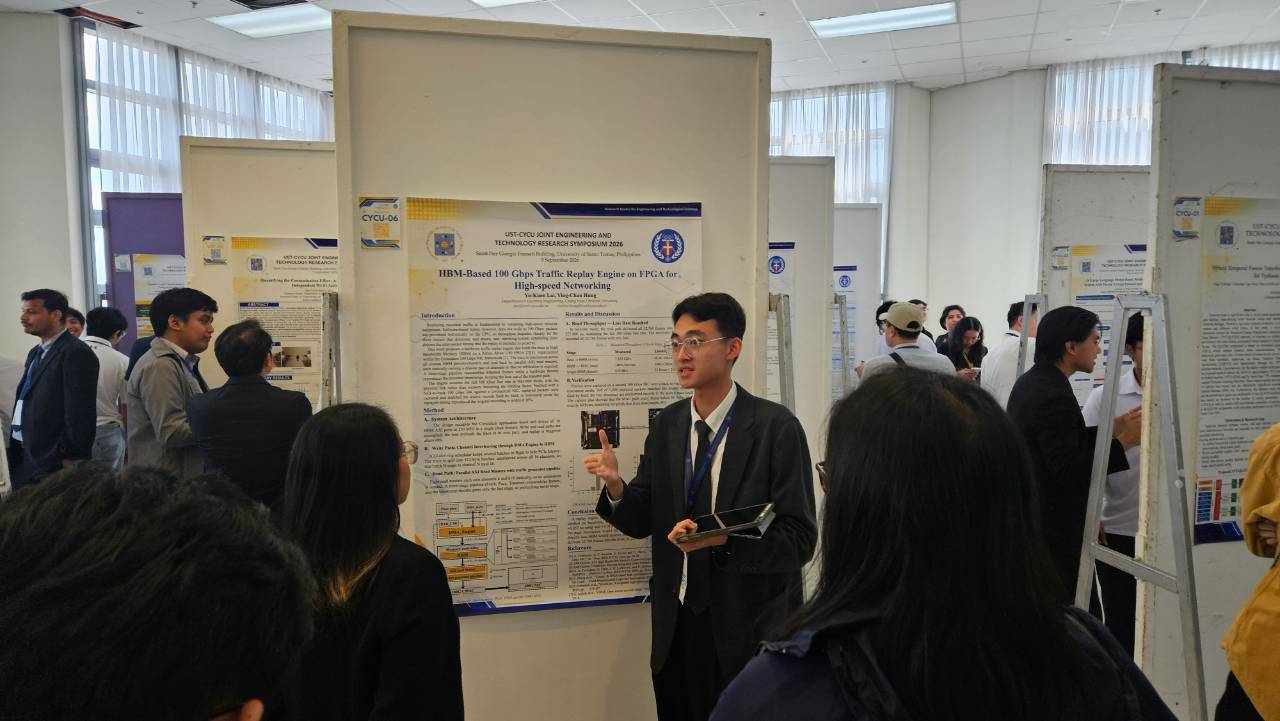
The UST–CYCU Joint Forum brought together more than 100 faculty members and students from both universities to exchange research findings through keynote lectures, paper presentations, poster sessions, and competitions. The forum covered a wide range of emerging technologies, including sustainable energy, quantum computing, power electronics, medical imaging, connected vehicles, artificial intelligence, big data, and cybersecurity. Distinguished Professor Ying-Yi Hong delivered a keynote on sustainable energy and quantum computing applications, while Professors Yi-Lin Ho, Wen-Cheng Lin, Hsien Hsia, Yi Cha, and Yu-Kun Lai also presented their latest research. The diverse topics highlighted CYCU’s interdisciplinary research strengths in electrical engineering, information technology, and smart computing, while giving students valuable opportunities to strengthen research presentation, professional communication, and cross-cultural exchange skills.

For students, the visit also provided valuable experience in presenting their research on an international stage and using English for professional academic exchange. Sheng-Yu Hsieh, a senior student in the Department of Electrical Engineering, said that presenting his research at an overseas conference for the first time and interacting with local students allowed him to reassess his work from different perspectives. Yi-Cheng Lee, a senior student in the College of Smart Computing, noted that preparing an English-language poster and engaging in on-site discussions helped him better understand the importance of professional presentation and English communication skills, while also giving him greater clarity about his future learning goals.
師生交流研究成果,從跨領域對話中拓展研究視野。.jpg)
Graduate students also gained valuable international academic experience through the exchange. Yu-Sheng Tu, a first-year master’s student in Electrical Engineering, said that faculty research presentations and poster discussions strengthened his confidence in presenting research in English. Kuan-Wei Lu, a second-year master’s student, noted that the program broadened his international perspective while improving his English communication and research presentation skills. Tsung-Wei Yu gained a deeper understanding of Philippine culture through campus exchanges, poster competitions, and local experiences, while also becoming more confident in initiating conversations in English. Sheng-Kai Lee, meanwhile, was impressed by the country’s churches, historic districts, and urban landscape, which offered a cultural experience distinct from Taiwan. From academic presentations to cultural exploration, the program helped students develop professional communication skills, cross-cultural understanding, and greater readiness for international mobility.
Beyond the bilateral forum, the CYCU delegation, led by Distinguished Professor Ying-Yi Hong of the Department of Electrical Engineering, also expanded its engagement with higher education institutions in the Philippines. The group visited De La Salle University (DLSU), Adamson University, National University (NU), the Technological University of the Philippines (TUP), and the Technological Institute of the Philippines (TIP) to discuss potential collaboration in areas including memoranda of understanding, student internships and exchanges, joint research, laboratory visits, and co-hosted international conferences. Professor Shih-Che Hsu, Section Chief of the Office of International and Cross-Strait Education, together with faculty members from the Department of Electrical Engineering and the College of Smart Computing, also introduced CYCU’s international education initiatives, teaching and research strengths, and research development, further deepening partner institutions’ understanding of CYCU.

During the visit, the CYCU delegation also met with Ambassador Min-Kan Chou of the Taipei Economic and Cultural Office in the Philippines. Discussions focused on Taiwan–Philippines educational cooperation, support services for students and alumni, opportunities for Filipino students to pursue higher education in Taiwan, and the promotion of Taiwan Scholarship programs. The meeting further strengthened connections among higher education institutions, overseas alumni networks, and international talent resources.

In addition to academic and institutional collaboration, CYCU’s Department of Electrical Engineering also organized an alumni gathering in the Philippines, bringing together more than 36 graduates who had studied at CYCU. One alumnus even traveled from Malaysia to Manila for the reunion. Many of these graduates now serve as deans, professors, and lecturers at universities in the Philippines, continuing to contribute to higher education and talent development.
Among them was the family of Dr. Arnold Paglinawan, a member of the first cohort of Philippine students who came to CYCU for doctoral studies in 2008 and a former dean of the College of Computer and Information Science at Mapúa University. His wife also attended the gathering and reunited with former faculty members. Spanning generations and national borders, the alumni reunion not only strengthened long-standing ties, but also demonstrated the lasting educational impact of CYCU’s sustained commitment to international talent development.

Professor Yu-Kun Lai, Chair of CYCU’s Department of Electrical Engineering, noted that the exchange program had been in preparation for more than six months. In addition to strengthening ties with overseas alumni, the initiative placed particular emphasis on expanding international partnerships and advancing substantive laboratory-level collaboration.
From the inauguration of the research center and the inaugural UST–CYCU Joint Forum to student poster competitions, visits to six universities, and the overseas alumni reunion, the program closely connected research collaboration, international talent development, and alumni engagement. Through these efforts, CYCU continues to put its commitment to holistic education and internationalization into practice, while creating diverse opportunities for students and faculty to engage in cross-cultural learning, international research collaboration, and global academic mobility.


代表領獎。(頒獎人為教育部政務次長劉國偉).jpg)