


Parents Gain First-Time Access to Core Laboratories and Talent Training Model.
CYCU held its 2025 Parent–Teacher Forum for Incoming Students on November 29. Among the university-wide activities, the Department of Electrical Engineering (EE) hosted an Open House and Parent–Teacher Forum, attracting nearly 70 parents of freshmen as well as junior and senior students. For the first time, parents were invited into the department’s key laboratories, offering an in-depth look at CYCU’s talent development model in electrical engineering.
EE Department Chair Dr. Lai Yu-Kun emphasized that students are at a crucial stage of academic advancement, internships, and career planning. The event aimed to help parents understand the department’s direction, learning environment, and future opportunities, strengthening their role as partners in student growth.
The forum opened at the Hsiu-Te Auditorium in the Chang Ching-Yu Memorial Library, where Dr. Lai presented an overview of the department’s development, curriculum structure, faculty profile, and student body. Established in 1972, the CYCU EE Department has grown for more than 50 years and now enrolls approximately 110 undergraduate students annually, with a total of around 500 students across all programs, including master’s, doctoral, and international students. With over 6,000 alumni excelling across global technology industries, the department continues to expand its research in power and energy, intelligent control and signal processing, communications and networking, machine learning, and deep learning. Its strong emphasis on integrated domain-specific system expertise remains a defining strength in interdisciplinary engineering education.

In response to the rapid advancement of AI technologies and the growing demand for interdisciplinary applications, the CYCU Department of Electrical Engineering (EE) emphasized the importance of strong foundational knowledge and cross-domain competencies. The department highlighted its commitment to “solid fundamentals and deep professional training,” equipping students with the skills needed to excel across diverse technological fields.
The department also introduced a range of international opportunities, including exchange and internship programs with Tokyo Denki University, dual master’s degree pathways with Kansai University and the University of Wisconsin–Milwaukee, and a joint academic workshop on power and energy with Meiji University, broadening students’ global learning experiences.

During the laboratory showcase, faculty members presented the latest research and facilities across active noise control, renewable energy and green power systems, and electronic circuits—demonstrating advancements aligned with global trends such as smart grids and net-zero emissions. The electronics laboratory, equipped with a one-student-per-station setup, highlighted the department’s strong emphasis on hands-on engineering training.

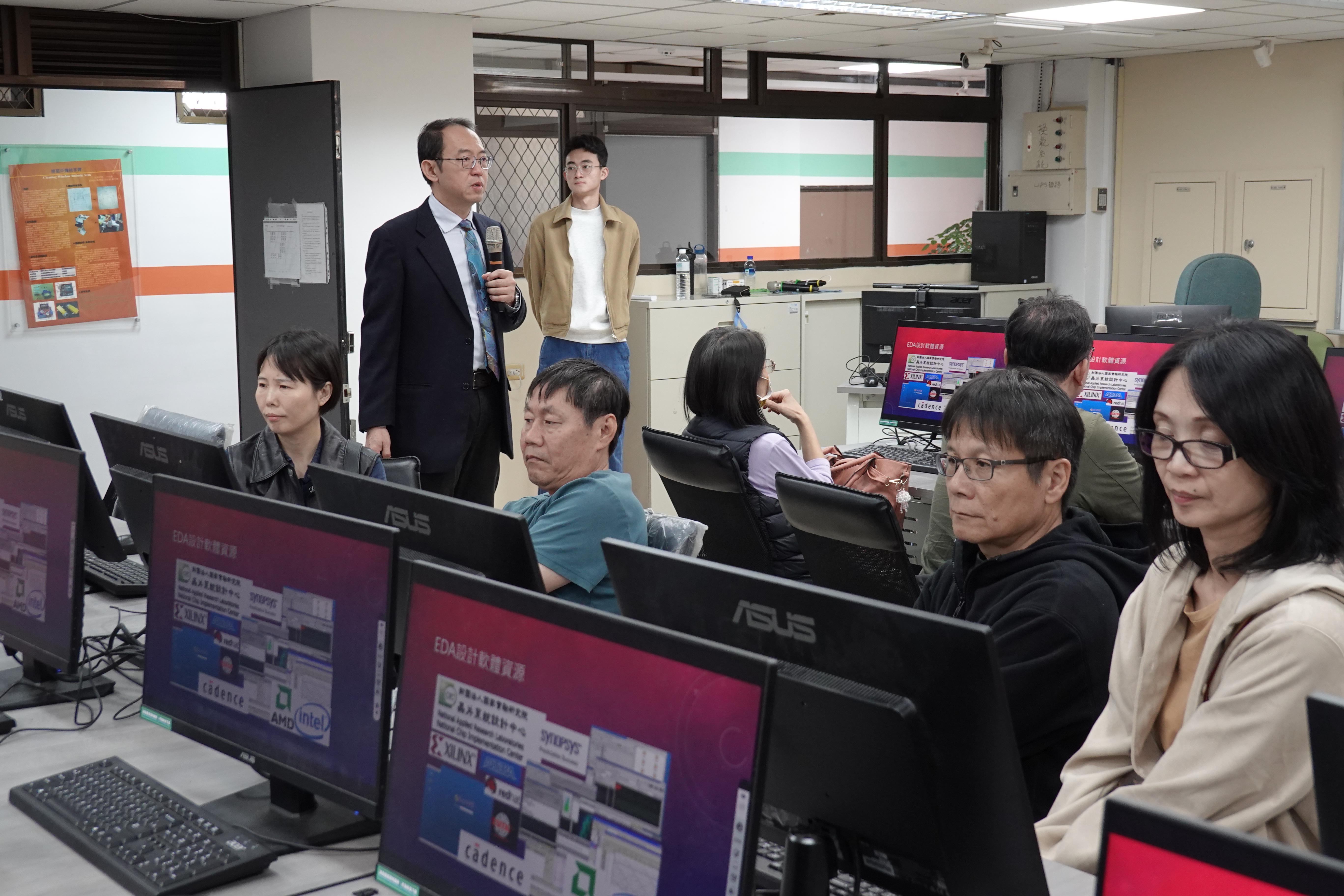
Parents then joined faculty mentors for an informal luncheon on the third-floor terrace of the EE Building, engaging in conversations about coursework, student performance, and future pathways. Afternoon lab tours were conducted in four groups, featuring the Active Noise Control Lab, Electronics Lab, Robotics Lab, and Integrated Circuit (IC) Design Co-Creation Lab. Parents had the opportunity to experience noise reduction technology, observe circuit measurement environments, learn about robotic systems and intelligent controls, and explore advanced IC design tools, high-performance servers, and NVIDIA GPU clusters—gaining a comprehensive understanding of the department’s robust engineering education environment.

Following the laboratory tours, parents gathered at the Yin-Ye Lecture Hall in the EE Building for an in-depth forum with faculty members and military instructors. Parents actively engaged in the discussion, raising questions on topics such as student life and campus adjustment, opportunities for international exchange and overseas study, dual-degree application procedures, industry internships, and pathways for participation in industry–academia collaboration. Their involvement reflected strong support and keen interest in their children’s academic and career development.

In response to the wide range of questions from parents, faculty members and military instructors provided detailed explanations from the perspectives of academic policies, available resources, and student competency development. They outlined the department’s efforts and achievements in international partnerships, industry collaboration, and interdisciplinary training—including overseas curriculum pathways, internship selection mechanisms, opportunities for students to join research projects, and various campus support services.
Through clear and transparent discussions, parents gained a deeper understanding of the department’s strong global network and diverse industry internship resources. Many expressed appreciation for the EE Department’s balanced approach, combining academic rigor with practical, industry-oriented training—helping students build essential competencies in a rapidly evolving technological landscape.
Department Chair Dr. Lai Yu-Kun noted that the EE Department will continue to focus on sustainable energy technologies, intelligent computing, and integrated circuit design as its core development areas. Guided by CYCU’s commitment to holistic education, the department aims to nurture engineering talent with global vision, innovation capability, and social engagement—contributing new momentum to technological advancement in Taiwan and beyond.