



Guided by its commitment to holistic education, Chung Yuan Christian University (CYCU) continues to advance an integrated talent-development approach that bridges academic learning with real-world application. Through close industry–academia collaboration, coursework and research projects are directly connected to industrial practice, enabling students to address authentic engineering challenges beyond traditional papers and reports.
Recently, the RF Research Laboratory of CYCU’s College of Electrical Engineering and Computer Science partnered with MSI (Micro-Star International) on practical engineering topics such as mitigating electromagnetic interference in laptop antennas. The collaboration not only contributed to product design optimization but also resulted in research outcomes presented at an IEEE international conference, highlighting CYCU’s concrete achievements in cultivating advanced engineering talent and strengthening industry engagement.
A capstone project by a CYCU student, highly recognized by MSI at a 2023 college competition, became the starting point for deeper industry–academia collaboration, highlighting students’ strengths in RF antenna design and system simulation.
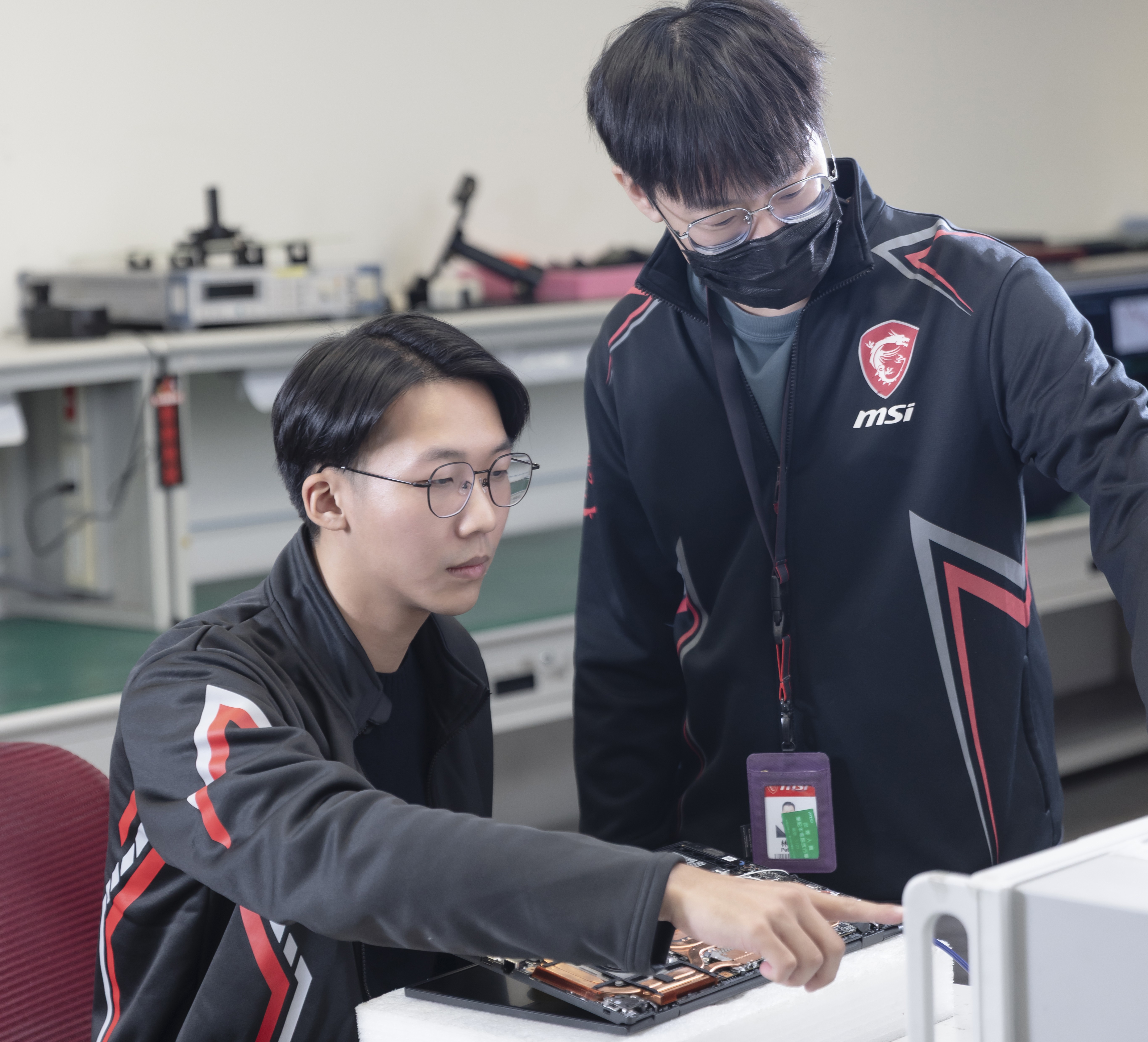
The research outcomes have been presented at major international conferences, including the 2025 IEEE Asia-Pacific International Symposium on Electromagnetic Compatibility (APEMC) and the 2025 IEEE Asia-Pacific Microwave Conference (APMC), demonstrating Chung Yuan Christian University’s strong research capabilities and international engagement in RF antennas, electromagnetic compatibility, and high-frequency system design. Students’ opportunities to present as first authors on the international stage further reflect CYCU’s commitment to hands-on research and global connectivity.
According to Prof. Chung-Hao Huang, advisor of the RF Research Laboratory, the lab’s recent research focuses on RF antennas and AI applications, electromagnetic interference mitigation, AI-assisted engineering design, and digital twin technologies for virtual power plants and intelligent systems. Through collaborations with the National Science and Technology Council, ITRI, local governments, and industry partners, students develop strong engineering skills, interdisciplinary thinking, and problem-solving abilities, preparing them for industries at the intersection of AI and high-frequency communications.

The College of Electrical Engineering and Computer Science at Chung Yuan Christian University emphasized that its long-term, in-depth industry–academia collaboration model enables students not only to conduct research, but also to gain a deep understanding of industry needs, R&D processes, and engineering constraints, effectively transforming theory into practical, deployable solutions. By working closely with industry engineers during the research phase, students build strong, job-ready capabilities for future careers in the technology sector.
CYCU emphasizes an application-oriented education model, continuously strengthening the integration of teaching, research, and industry needs through close industry–academia collaboration. By engaging students in real-world projects, CYCU cultivates practical engineering competence and strong R&D capability. Moving forward, the University will further deepen partnerships with industry, expand into emerging research areas, and nurture technology professionals who combine technical expertise with humanistic values, contributing to Taiwan’s industrial advancement and global competitiveness.