


Students from Chung Yuan Christian University’s College of Design delivered an outstanding performance at the 2026 Golden Pin Design Award for Young Designers, standing out among 4,465 entries submitted by 55 universities and 110 academic departments nationwide. Several projects received prestigious honors, including The Caspian Art Museum, which won the Special Award in Packaging Design, and Blind Spot, which was recognized in the Social Design category. In addition, Within the Herbal Cycles from the Department of Interior Design received the Mu Shui Interior Design Special Award, highlighting CYCU’s achievements in interdisciplinary design education and socially engaged practice.
Organized by Taiwan’s Industrial Development Administration under the Ministry of Economic Affairs and executed by the Taiwan Design Research Institute, the Golden Pin Design Award for Young Designers is one of the most prestigious awards in design education in Taiwan. This year, only 122 projects received awards out of 4,465 submissions, reflecting the highly competitive nature of the competition.

This year, 20 graduation project teams from CYCU’s Department of Commercial Design participated in major design competitions, with more than 13 teams shortlisted for national-level awards. At the 2026 Golden Pin Design Award for Young Designers alone, 11 teams received nominations and earned a total of 15 awards, marking the department’s best performance to date. The achievement reflects students’ strengths in creative practice, social awareness, and interdisciplinary collaboration.
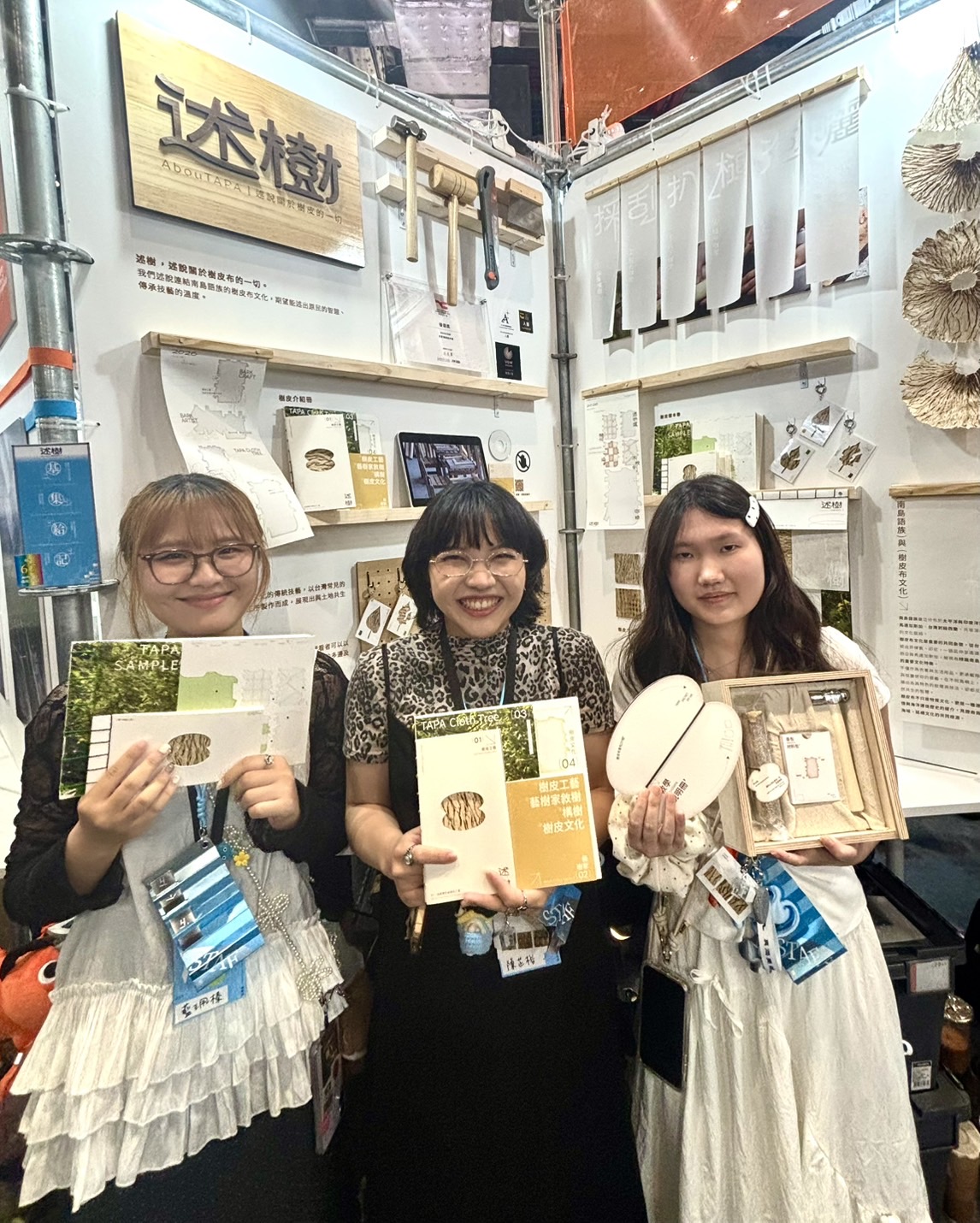
Among the recognized projects was AbouTapa, which reinterprets the Indigenous barkcloth tradition through a multisensory experience that engages sight, sound, touch, and smell. By exploring the historical context and cultural significance of this traditional craft, the project offers a contemporary approach to cultural storytelling and heritage preservation. It was also honored with an Honorable Mention in the Visual Communication Design category at the Youth Innovative Design Festival, demonstrating how design can serve as a bridge between cultural memory and contemporary audiences.
Recognized in the Social Design category, Blind Spot was created by students Huang Jui-Lin, Lai Wei-Hsun, and Liao Ting-Hui under the guidance of professors Chang Tao-Pen and Chang Chun-Chieh. Focusing on the everyday experiences of people with visual impairments, the project combines in-depth interviews, field observations, and immersive design to create an interactive system that simulates various eye conditions. Through the use of vision-simulation lenses, audiovisual installations, and digital interactive games, visitors are invited to experience the challenges faced by visually impaired individuals in their daily lives. By moving participants beyond simply seeing disability toward understanding it, the project encourages reflection on accessibility, inclusion, and equal participation in society.

The Caspian Art Museum, which received the Special Award in the Packaging Design category, was also developed under the guidance of professors Chang Tao-Pen and Chang Chun-Chieh by students Wang Yi-Ya, Yang Yu-Jen, and Lin Chia-Kai. Centered on the traditional stone weir culture of Xinwu in Taoyuan, the project was informed by extensive field research along the coastline. The team transformed the concept of stone weir fishing into a set of functional “stone weir crayons” and designed an interactive package inspired by the rhythms of the tides. Through the acts of opening the package and creating drawings, users are encouraged to rediscover the cultural memory and sustainability values embedded in coastal communities.
By combining cultural preservation with innovative design, the project transforms local heritage into an engaging and shareable experience for contemporary audiences. In addition to being recognized at the Golden Pin Design Award for Young Designers, The Caspian Art Museum also received an Honorable Mention at the A+ Creative Festival for Cultural Heritage.

In the field of spatial design, Within the Herbal Cycles, created by Department of Interior Design students Li Yi-Ching and Chang Ko-Ming under the guidance of Professor Chen Shao-Ping, received the Mu Shui Interior Design Special Award at the 2026 Golden Pin Design Award for Young Designers. Centered on the healing traditions of local medicinal herbs, the project integrates the rhythms of the four seasons, the philosophy of the Five Elements, and natural landscapes to create a multifunctional environment for relaxation, wellness, and cultural engagement. Through thoughtful spatial design, the project reimagines a lifestyle rooted in harmony between people and nature, offering a contemporary interpretation of sustainable and holistic living.

Chao Chia-Lin, Dean of the College of Design at Chung Yuan Christian University, noted that this year’s award-winning projects span a wide range of fields, including social design, cultural heritage preservation, sustainable innovation, interactive experiences, packaging design, and spatial design. Through long-term field research, community collaboration, and interdisciplinary integration, students transformed their observations into meaningful design solutions.
“Good design is not only about solving problems—it must also respond to the needs of society,” Chao said. From accessibility and social inclusion to local revitalization and cultural preservation, CYCU students have demonstrated how design can serve as a powerful tool for addressing contemporary social issues. Their achievements reflect both professional excellence and a strong commitment to human-centered values, embodying the core mission of design education.

CYCU emphasized that design is more than an expression of creativity and aesthetics—it is also a powerful tool for addressing social needs, fostering inclusion, and advancing sustainable development. In response to the challenges of a rapidly changing world, the university remains committed to encouraging students to use design as a bridge connecting culture, technology, and society. By transforming creative ideas into practical solutions, CYCU aims to empower students to make meaningful contributions to sustainable development and positive social change.